The Advice You Follow Is Slowing You Down
Early in my career I collected advice the way some people collect books they never read. A manager told me to always match the customer's energy, so I did. A trainer told me the customer is always right, so I agreed with people I knew were wrong. I followed every rule handed to me, and my results stayed flat for years... because I'd never once asked whether any of it applied to the person actually sitting in front of me.
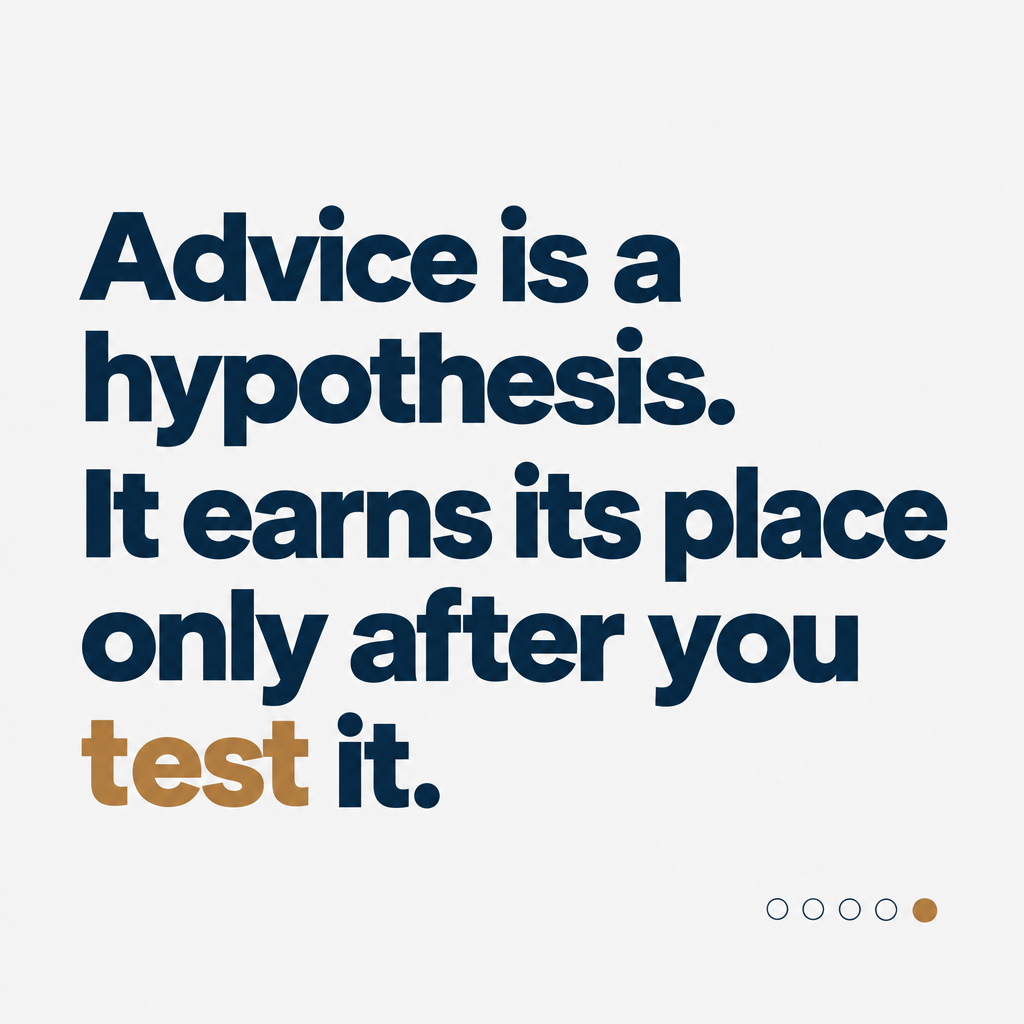
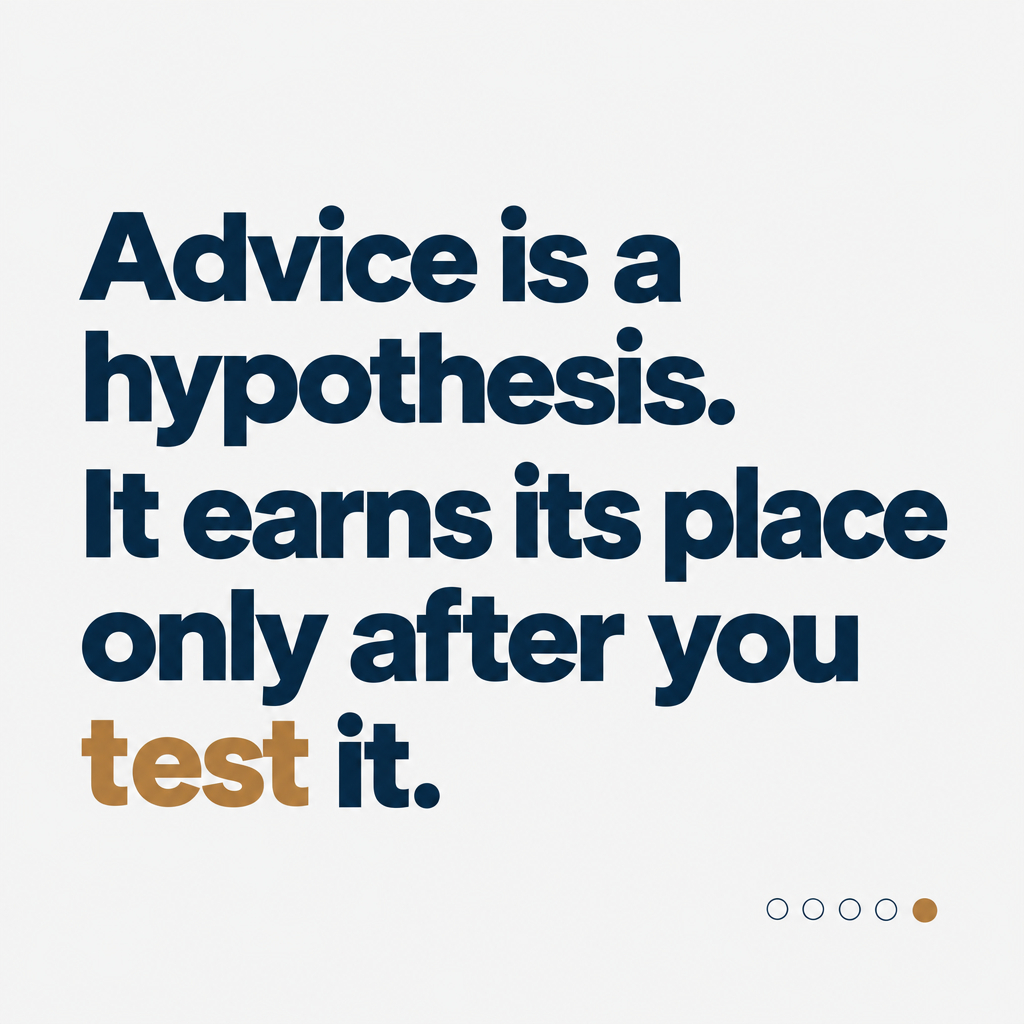
Here's what I've learned since. Advice is a hypothesis, and a hypothesis earns its place only after you test it. The guidance that stalls you is almost never the obviously bad kind. It's the reasonable-sounding kind you adopted without running it through your own situation, your own clients, your own read of the room.
The numbers suggest I wasn't alone in this. In 2025, 78% of sellers missed quota, up from 69% the year before, while reps spent only 28-30% of their week actually selling. That's an industry full of talented people executing borrowed playbooks with tremendous discipline. The discipline is admirable. The playbooks deserve more scrutiny than they get.
Where the Oldest Advice Came From
Consider the most repeated line in the profession. "The customer is always right" was coined in 1909 by Harry Gordon Selfridge as a retail marketing slogan. It was never a field-tested principle for complex sales relationships. Over a century later, researchers and business writers have documented how following it unthinkingly damages staff morale, increases costs, and rewards unreasonable behavior.
Henry Ford understood the limit of this thinking. When asked about giving customers exactly what they wanted, he replied that they would have simply ended up with a faster horse. Customers know their pain intimately. They rarely know the full landscape of solutions... that's the part you bring.
I spent years agreeing with clients as a default setting, and I can tell you what performed agreement produces. It produces polite meetings, warm handshakes, and deals that quietly die because I never earned the standing to tell someone their plan had a hole in it. The turning point in my career came when I started disagreeing out loud, respectfully, with evidence. Clients leaned in. They'd been waiting for someone in the room to act like a peer instead of an applause track.
Vetting Beats Adopting
So how do you separate advice worth keeping from advice worth retiring... I use a simple filter now, and it starts with treating every claim as unproven until my own observation confirms it. When someone hands me a technique, I run it in low-stakes situations first. I watch what actually happens, compare it against what the advice promised, and only then stamp it as mine or discard it.
This matters more now than it did when I started, because the buying environment has quietly rewritten the rules underneath the old scripts. B2B buyers complete 57-70% of their research before they ever reach out, and 73% of them actively avoid sellers who send irrelevant outreach. The prospect across the table already knows the surface-level pitch. Advice built for an uninformed buyer fails against an informed one, and much of what circulates in sales training was built decades before this shift.
💡 A practical test: take one piece of sales wisdom you've followed for over a year without questioning it. Write down what it predicts should happen when you use it. Track your next ten interactions against that prediction. You'll learn more from that small experiment than from another course.
Read the Room Instead of the Script
The second casualty of borrowed advice is observation. When you walk into a conversation running someone else's script, your attention goes to executing the script. When you walk in with your own vetted understanding, your attention goes to the person... their pace, their hesitations, the signals about what actually worries them.
I learned this the uncomfortable way. For years I made quiet assumptions about what people could afford based on first impressions, and I softened my numbers accordingly. Then I started paying attention to the actual evidence in front of me, and I discovered my assumptions were wrong often enough to be expensive. The prospect I'd mentally discounted turned out to be the biggest deal of my quarter. Surface appearances told me almost nothing... observed behavior told me nearly everything.
This is where I'll use my one structural comparison, because it fits. The best conversations I've had were ones where I'd already sketched the blueprint before walking in. I knew the destination, the likely detours, and the objections that would surface at each stage. Discovery, done right, builds that map. It gathers information and it also shapes the path, so pricing lands as a natural milestone instead of an ambush at the end.
Confidence Is an Inside Job
Pricing is where inherited advice does its quietest damage. Research shows that customer-oriented salespeople create real value for customers yet fail to capture that value in negotiations unless they genuinely believe their prices are justified. Flinching at your own number telegraphs uncertainty, and buyers read it instantly. The same research notes that a $49,999 price signals hesitation where a clean $50,000 signals confidence.
I used to flinch. What fixed it was doing the internal work... understanding precisely why my offer was worth the number, so the number became a statement of fact rather than an opening bid I secretly expected to lose. That confidence came from my own vetted understanding of the value. No script could have supplied it, because scripts supply words and buyers respond to conviction.
⚠️ Worth watching for: when you feel the urge to discount before the client has even objected, the problem usually lives in your own certainty about the value, and that's the place to dig first.
Authenticity Compounds, Techniques Decay
There's now solid evidence behind what field experience taught me slowly. Studies show authenticity strongly enhances trust, and that trust strongly predicts loyalty... with research linking perceived organizational authenticity directly to store-level sales growth in real retail environments. Trust also reduces the need for external validation entirely. The stronger the relationship, the less clients rely on references, because your credibility speaks for itself.
Authenticity includes the willingness to walk away. Some of the best long-term decisions I've made involved telling a prospect that a competitor served their situation better. It cost me revenue that quarter, and it built a reputation that sent referrals my way for years afterward. All money isn't good money, and the wisdom to decline a poor-fit deal is a character decision that pays compound interest.
I'd add one more habit that inherited sales advice never mentions. Feed your mind far outside the profession... art, history, whatever pulls your curiosity during dead time in the car. I've watched knowledge I picked up for no professional reason resurface years later in a client conversation and open a door no technique could have opened. Well-rounded people hold better conversations, and better conversations close better business.
What I'd Leave You With
Here's the recap, and you get to choose which piece fits your situation first. Treat all advice as a hypothesis and test it against your own observed results before adopting it. Retire the century-old slogans that were marketing copy in 1909 and remain marketing copy today. Build your map before the conversation so you shape the path instead of reacting to it. Do the internal work on your pricing until the number feels like a fact. Trade performed agreement for honest, respectful candor, since that's what actually builds trust. And feed your curiosity broadly, because the knowledge you gather today shows up in rooms you can't yet predict.
The advice worth following is the advice you've tested against what's actually in front of you. Everything else... however confidently it was handed to you... is someone else's hypothesis wearing the costume of a rule.