



Stay Ahead of the Curve
Explore Our Latest Blog Posts & Articles
The Consulting Industry Is Splitting in Two, and Most Firms Haven't Noticed
We've spent years watching a quiet divide open up in professional services. On one side sit firms that diagnose, deliver a deck, and leave. On the other side sit partners who stay through implementation and accept accountability for what actually happens next. The gap between those two models keeps widening, and clients are the ones forcing it open. At GPJ Advisors, we built our entire practice around that shift, because the data tells a story most of the industry still resists.
Here's what we know. The coaching and performance industry is growing at a pace that surprises even the people inside it. The global coaching industry generated $5.34 billion in revenue in 2025, nearly double the $2.85 billion reported in 2023, with practitioner numbers up 54% in six years. Growth like that signals real demand. It also signals something else... a market flooding with providers, where clients will learn quickly to separate advice from results.
The Accountability Shift Is a Universal Pattern, and It Keeps Repeating
Every maturing service industry follows the same arc. Early buyers accept promises. Experienced buyers demand proof. The coaching and consulting market has now crossed that line, and the firms still selling transformation on faith are feeling the friction. Clients today walk into conversations with CFO-grade questions about return, timelines, and measurement.
The evidence backs their skepticism, and it also backs the investment when it's done right. Organizations report an average ROI of 600% from coaching investments, and 77% of executives said coaching had a significant impact on at least one major business metric. Those numbers only materialize when coaching connects to real operating decisions. Coaching that floats above the business, disconnected from strategy and execution, produces satisfaction scores and little else.
We've watched this play out inside organizations of every size. The engagements that fail share a common structural flaw... they treat insight as the deliverable. The engagements that succeed treat insight as the starting point and implementation as the actual work. That distinction explains most of the variance in outcomes we've observed, and it's why we frame our practice around strategy, execution, and results as a single connected system.
Why Training Alone Keeps Failing, and What the Data Says About It
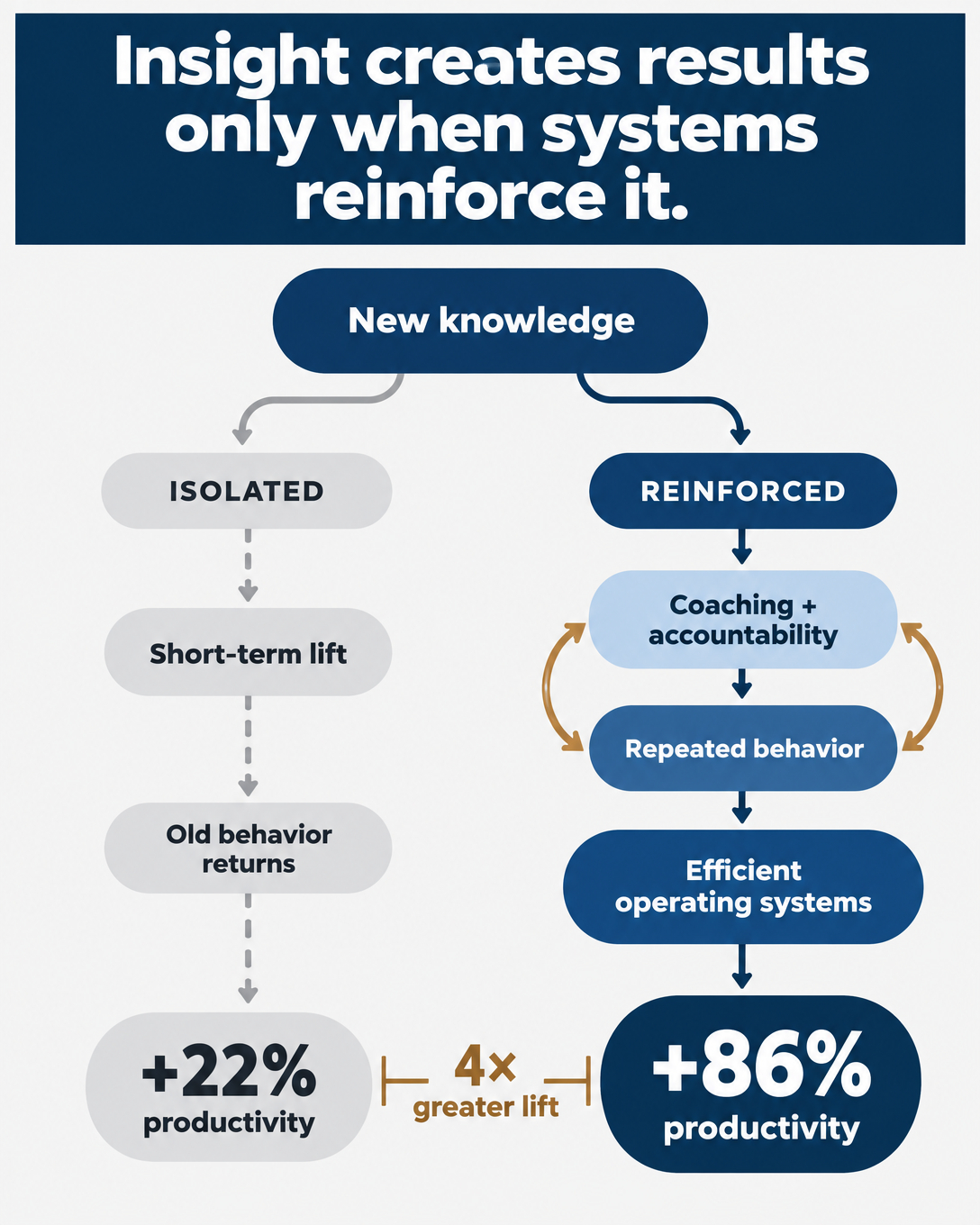
This is one of the most commonly overlooked patterns in organizational development. Companies invest heavily in training programs, watch the energy fade within weeks, and conclude that development doesn't work. The research points to a different conclusion. Training combined with coaching boosts productivity by 86%, compared to 22% from training alone.
That fourfold difference reveals a universal law of behavior change. Knowledge transfers in a classroom. Capability builds through repetition, feedback, and accountability over time. When you drop training into an organization without the coaching layer that reinforces it, you've handed people a blueprint with no construction crew. The knowledge exists, and nothing gets built with it.
We see this same pattern in sales organizations constantly. Teams attend methodology workshops, everyone nods, and win rates stay flat. Effective coaching produces consistent behavior change that moves both leading indicators, like conversation quality and discovery depth, and lagging indicators, like win rate and quota attainment. Even a modest lift compounds fast... a win rate moving from 20% to 23% translates into meaningful revenue when you multiply it across a team's full deal volume and value.
The takeaway for you as a leader is straightforward. Evaluate any development investment by asking whether it includes the reinforcement layer. If the answer is no, the productivity data suggests you're funding the 22% outcome when the 86% outcome was available.
Leadership Development Has Become a Financial Performance Variable
The industry conversation around leadership development has shifted from culture language to balance sheet language, and the numbers explain why. Organizations that invest in leadership development report a 25% increase in business outcomes, and engaged leadership links to 21% higher profitability. More striking to us... 54% of organizations offering leadership development at all levels report being in the top 10% of their industry's financial performance, while organizations offering no effective programs cluster at the bottom.
There's a multiplier mechanic underneath these numbers that we find genuinely fascinating. When a leader receives ongoing development, 68% of their employees report improved performance. Develop one person, and the effect propagates through every team they touch. That multiplication is why leadership development consistently outperforms other interventions on a per-dollar basis, and why we treat it as a core pillar rather than an add-on service.
The retention data sharpens the picture further. Research shows 72% of high-potential employees would leave their current organization for one offering better leadership development opportunities. Your best people are already evaluating you on this dimension, whether or not it shows up in exit interviews. Meanwhile, 59% of organizations report improved retention from their leadership programs, which means the same investment that builds capability also protects the talent you've already developed.
Operational Improvement Is Where People Work Finally Pays Off
We've noticed a persistent blind spot in how organizations sequence their improvement efforts. They develop leaders, coach teams, and then wonder why results plateau. The plateau almost always traces back to operations... processes that absorb the new capability and convert it into waste. Companies with top operational excellence show 25% higher growth and 75% higher productivity than their peers, and streamlined processes commonly deliver cost reductions of 15% to 30% in operations overhead.
The timeline data matters here too. Benchmarks like IBM's reported 20% improvement in client operational efficiency within six months show that operational transformation moves faster than most leaders expect. Lean approaches routinely cut process cycle times by 40% to 60%. These are measurable, near-term results, which is exactly what a market demanding accountability wants to see.
This is why we advocate for addressing leadership, sales performance, and operations as one connected effort. Capability without efficient systems stalls. Efficient systems without capable people decay. The organizations pulling ahead right now work both dimensions at once, and the compound effect is what competitors find hardest to copy.
What This Trend Means for You, and Where We'd Start
The investigative thread running through all of this points one direction. The consulting industry is consolidating around integrated, accountable, implementation-focused partnership, and the market data rewards clients who choose that model. Clients report it themselves... 60% of business coaching clients report higher revenue or productivity after coaching, and 58% say it improved their decision-making. Those outcomes come from sustained work, honest measurement, and a partner willing to stay in the room when things get difficult.
We won't pretend this work is easy. Change is hard, and it happens through steady, compound effort rather than dramatic overhauls. Small improvements, reinforced consistently, stack into transformations that look sudden from the outside and were anything but. That's the workable path, and in our experience it's the only one that holds.
You have options for how to act on this. You can audit your current development spend against the training-plus-coaching benchmark. You can map where operational friction is absorbing the capability you've already built. You can evaluate any external partner on whether they accept accountability for measurable outcomes. Choose whichever entry point matches your biggest constraint right now.
The Recap
Here's what we covered, condensed. The coaching and consulting market nearly doubled in two years, and buyer sophistication is rising with it. Training alone produces a 22% productivity gain while training plus coaching produces 86%, so the reinforcement layer determines the return. Leadership development links directly to profitability, engagement, and retention through a multiplier effect that runs through every team a developed leader touches. Operational improvement converts human capability into financial results, often within six months.
The universal law underneath it all... integrated effort beats isolated effort, every time we've measured it. That's the principle we built GPJ Advisors around, and it's the standard we'd encourage you to hold any partner to, including us. Turning potential into performance is the whole job. Let's build your next breakthrough together.

Testimonials
Driving Growth, Amplifying Impact

Unleash Your Business Profits.
I guide serious business owners and organizations in focusing on the key activities and systems that support growth in clients, sales, and profits.